When Memory Fails: Why Eyewitness Is Unreliable


This review of literature is a collaboration between The Mangione Trial (studying a Master in Psychology), and Valentina (BSc Psychology).
“On October 27, 1985, a woman was raped in her home in Alexandria, Virginia (Scheck, Neufeld, & Dwyer, 2000). She told police that the room was too dark for her to clearly see the perpetrator’s face, but two neighbors reported seeing a man named Walter Snyder outside of his home, just across the street from the victim’s house, shortly before the attack.
The police questioned Snyder and took his photograph, which was later included in a set of mugshots that were shown to the victim. The victim did not identify Snyder as the perpetrator, but she lingered on Snyder’s photo and noted that his eyebrows looked familiar.
Months later, when Snyder returned to the police station, the investigator asked the victim to come in to view a potential suspect. When she saw Snyder in the lobby, she expressed a great deal of apprehension to the receptionist, who quickly ushered her downstairs to meet the detective. The victim told the detective, “The man who raped me is upstairs in the lobby”
Snyder was convicted and sentenced to 45 years in prison, largely on the basis of the victim’s testimony. Years later, Snyder’s family won approval to submit semen samples from the crime scene to recently developed DNA testing techniques. Three separate tests were conducted, all of which excluded Snyder as the rapist. Snyder was eventually pardoned by the governor after having served nearly seven years in prison.”
In psychology, for the past 30 to 40 years, one fact is very clear: eyewitness memory is unreliable. Like any other forensic evidence, eyewitness’ memory can be contaminated, distorted and therefore, unreliable. Despite that fact, eyewitnesses take an important place in legal cases, and can influence jurors to a guilty or not guilty verdict, changing the defendant’s life forever.
The Fragile Architecture of Memory
In the 70s, Elizabeth Loftus made the shocking discovery that memory is malleable, (Loftus, Miller & Burns, 1978). The results of this experiment showed that participants truly believed they saw a stop sign, when in fact, it was a yield sign. Later studies showed that detailed emotional and traumatic memories could be implemented in people’s memory, when they never experienced them. False memories feel truly as real as true ones, making it hard or impossible to restore to the actual memory of the events.
So, can memory truly be trusted? Memory relies highly on what was happening during the encoding process - memory making process.
Acute stress is commonly experienced during crimes which disrupts cognitive performance, attention control and face recognition accuracy.
When the crime happens, the witness can experience a biphasic stress response:
Fight-or-flight phase: sudden burst of energy to respond to the stressor - or a freezing response.
Recovery phase: physiological processes that repair and restore the body after stress.
These physiological changes modulate memory encoding processes as the attentional resources are already used to respond to the situation itself.
Initial Eyewitness Identification: Systemic Failures and Contamination Risks
Reliability for initial identification - whether pointing towards innocence or guilt - is maximized when collected early and uncontaminated, with optimal conditions. But is it possible in the current police system ?
Surveys show limited knowledge of eyewitness factors for Law Officers. In a U.S. Survey by Wise et al. (2019), officers averaged only 54% correct on a 11-item knowledge scale about eyewitnesses.
Currently, there’s no uniformity in the identifying procedures across the U.S. agencies. Many agencies haven’t implemented the NIJ’s Guide’s recommendation and many agencies still use non-blind simultaneous lineups, which are less reliable. Despite the NIJ’s Guide and Training Manual, U.S. law enforcement agencies are slow to adopt proper eyewitness reforms.
In Luigi Mangione’s case, it is truly difficult to trust policemen involved knowing the misconduct prior to the arrest, on the arrest-day itself and after the arrest. For e.g., a police sergeant in San Francisco had called the FBl’s New York Office to inform them that the suspected shooter resembled the missing persons case he was working on, talking about to Luigi Mangione. Some police officers involved in the case already knew Luigi Mangione prior to the arrest, this is raising questions about their biases.
The witnesses must not previously have been exposed to distorting and/or contaminating information. Pre-identification contamination can artificially boost confidence. For example, to see a suspect’s mugshot (online for example) before a police lineup, leading them to confidently select that individual, even if they are mistaken (Gronlund & Benjamin, 2018).
The photo of Luigi Mangione in a holding cell was released by the Altoona Police Department on the evening of Monday, December 9, 2024. This picture was posted on the day of the arrest, going viral with media covering it such as CNN and ABC news. This is difficult to believe that potential witnesses could’ve missed the coverage of the arrest, including the pictures.
Respecting these conditions is difficult because witnesses may be exposed to suggestive or confirming information from prosecutors, case officers and additional police interviews. (Wells, Olson, & Charman, 2003) The witness’ memory must be tested for the first time and the initial recall should be completed within 24h of the event.
Law officers must recognize factors at the crime scene that affect eyewitness accuracy - situational and personal factors during the crime that could affect accuracy.
Other factors can influence the eyewitness in the identification process:
Asking suggestive questions (Loftus, Miller & Burns, 1978),
Introducing post-event misinformation (Loftus, Miller & Burns, 1978)
Asking an abundance of closed questions (vs. open-ended questions: Lamb, Orbach, Hershkowitz, Horowitz & Abbott, 2007)
Repeated questioning (reconsolidation),
Encouraging/enticing witnesses to guess (vs. providing an option not to respond: Earhart, La Rooy, Brubacher & Lamb, 2014)
“Tricked” the witness into providing desired information (e.g., through the use of biased lineups or suggestive interview questions),
Feedback, which has powerful memory distorting effects,
Lack of fillers/lookalikes which should be similar to the suspect,
Not telling the witness that the perpetrator may not be present,
No “Blind” officer to administer the lineup.
There’s two types of lineups.
Sequential: photographs shown one at a time.
Simultaneous: photographs shown all at once.
In a 2001 survey, 63% of memory experts agreed that simultaneous lineups increase misidentification risk. Even though we know this, 66 % of US law enforcement agencies still use simultaneous lineups.
All these factors influence and significantly distort the witness memory and contribute to witness’ identifications errors. Once an interview is biased, memory errors are generally difficult to impossible to reverse.
Real-world conditions are rarely optimal and currently not respected most of the time. Over 50% of investigators ask about confidence in leading ways. Example: “So you’re pretty confident, right?” (MacLean et al.)
The APA (American Psychological Association) stated that even among strong confident witnesses, error rates can be high. Among eyewitnesses estimating their confidence rate to 90% to 100%, 40% of them actually were mistaken.
In 2001, 80% of experts agreed that eyewitness’ confidence is not a good predictor of accurate identification. The American Psychological Association (APA) estimates that eyewitnesses make an erroneous identification in about one out of every three cases, and this is a leading cause of wrongful convictions.
Any posterior identifications will be unreliable because the memory is distorted by the interview. When a memory is recalled, it becomes fragile, sensitive and malleable to changes. Some law enforcement agencies do not record the initial identification, and instead, rely on retrospective statements, which are less reliable. (Police Executive Research Forum, 2013)
The Limits of Identification Through CCTV Footage
CCTV footage is often used in court to show crimes and identify offenders, but the image quality is usually poor, making it hard to recognize people. CCTV images are often unclear, affected by lighting, angle, motion, distance from the location of the event, and camera quality. It has been reported that 80% of CCTV cameras are of poor quality.
Recognizing familiar faces, even from bad CCTV footage, is easy, while recognizing unfamiliar faces in the same situation is almost like guessing. (Burton et al., 1999)
People were very good at recognizing faces when the pose and lighting were the same in both pictures but accuracy dropped a lot when the pose or lighting was different. (Hill & Bruce, 1996)
In a fraud detection study, participants correctly rejected only 36% of cases, making a 64% error rate. Even when the people obviously didn’t look like the photos, the error rate was still high at 34%. This happened even though the participants knew about the study and were motivated to do well. (Kemp, Towell & Pike, 1997)
One study showed that trained and untrained participants demonstrated similar performance rates: with correct rates of matching at
- 67.3% for trained participants
- 67% for non-trained participants.
The results of training in face matching are limited. (Towler et al., 2014)
Police officers do not perform better than the general population on unfamiliar face matching tasks
When Luigi Mangione pulled down his mask, a police officer “instantly recognized him” as the wanted person from NYC. The police officer expertise was his own personal observation of national media reports - including the pictures circulating by the NYC Police Department. Within mere minutes, the officer knew with “about 100%” certainty that Luigi Mangione was the same individual depicted in the photos that New York law enforcement was seeking. Confidence is not reliable to predict accuracy. We can question the police officer’s identification by a confirmation bias.
Confirmation bias
1. the tendency to interpret new evidence as confirmation of one’s existing beliefs or theories.
An explanation could be that because the police officer was searching for the CEO’s shooter, he was prone to interpret information, Luigi Mangione’s appearance in this case, as confirming his preexisting belief, shaped by the manager’s call that the suspect resembled the CEO’s shooter.
Trial Eyewitness Testimony: A Contaminated Source of Evidence
Trial eyewitness testimony - courtroom testimony - about initial confidence is highly unreliable because eyewitnesses’ memories of their initial confidence have been contaminated and distorted by multiples factors such as (Garrett, 2011; Wells & Bradfield, 1998):
the interview itself (suggestion, police feedback, etc.),
the passage of time.
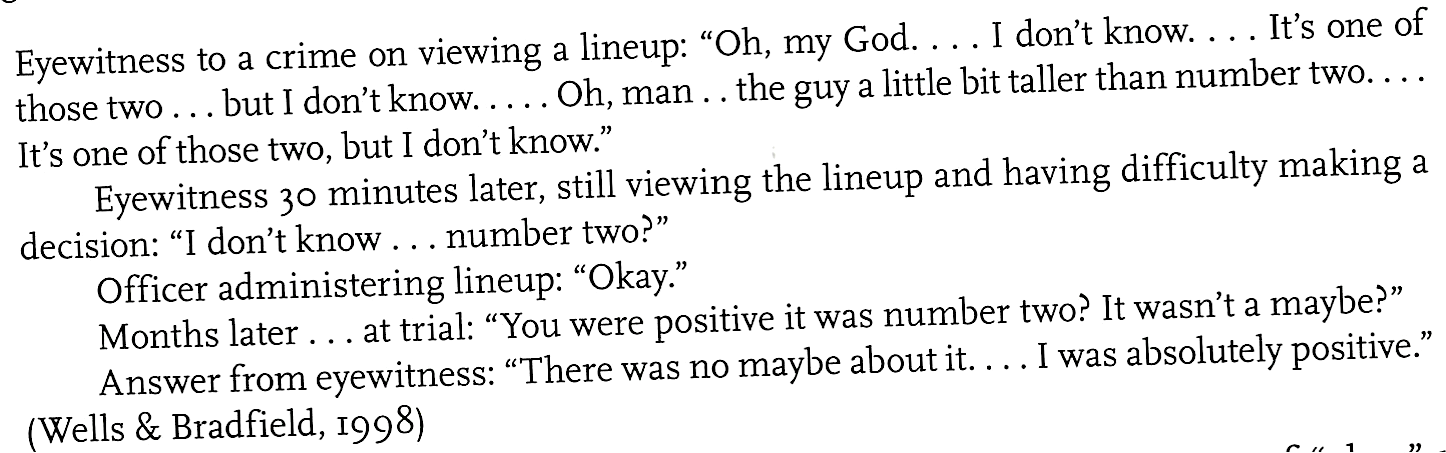
Eyewitness’ confidence is not stable through time, but rather, it evolves by being influenced by various influences between the crime itself and the end of the legal process, (Quinlivan, Wells, & Neuschatz (2010).
In some documented cases, witnesses initially expressed low confidence during the lineup initial identification but showed high confidence at trial, (Garrett, 2011). Though the confidence raised, the reliability did not.
Prosecutors have little knowledge about eyewitness testimony, being 47% correct on a 13-item knowledge scale, (U.S. surveys, Wise et al., 2015). Prosecutors tend to believe eyewitness testimony is highly reliable and underestimate the role of eyewitness error in wrongful convictions. But most importantly, prosecutors resist legal safeguards.
Judges, surprisingly, have a limited knowledge about eyewitness testimony. U.S. judges averaged 55% correct on a knowledge scale and struggle to apply their knowledge of eyewitness testimony to actual cases. Courts tend to overvalue trial testimony over the initial police record.
Judges also overestimate jurors’ knowledge about eyewitness reliability. The APA asserts that unreliability of eyewitness identifications is not understood by juries. Jurors have a limited knowledge of eyewitness memory and rely on poor accuracy predictors such as : the eyewitness’ confidence at trial, memory for minor details and the consistency of testimony.
What about educating jurors? Even when instructions are simplified and clarified, jury instructions fail to make jurors sensitive to eyewitness errors. This is consistent across multiple studies and instruction formats. (Greene, Ramirez et al, Bornstein and Hamm, Henderson instructions.)
Confidence is often used by jurors to judge accuracy, which is highly problematic knowing the trial identification is unreliable and contaminated. This phenomenon increases wrongful convictions.
Consequences of Eyewitness Misidentification
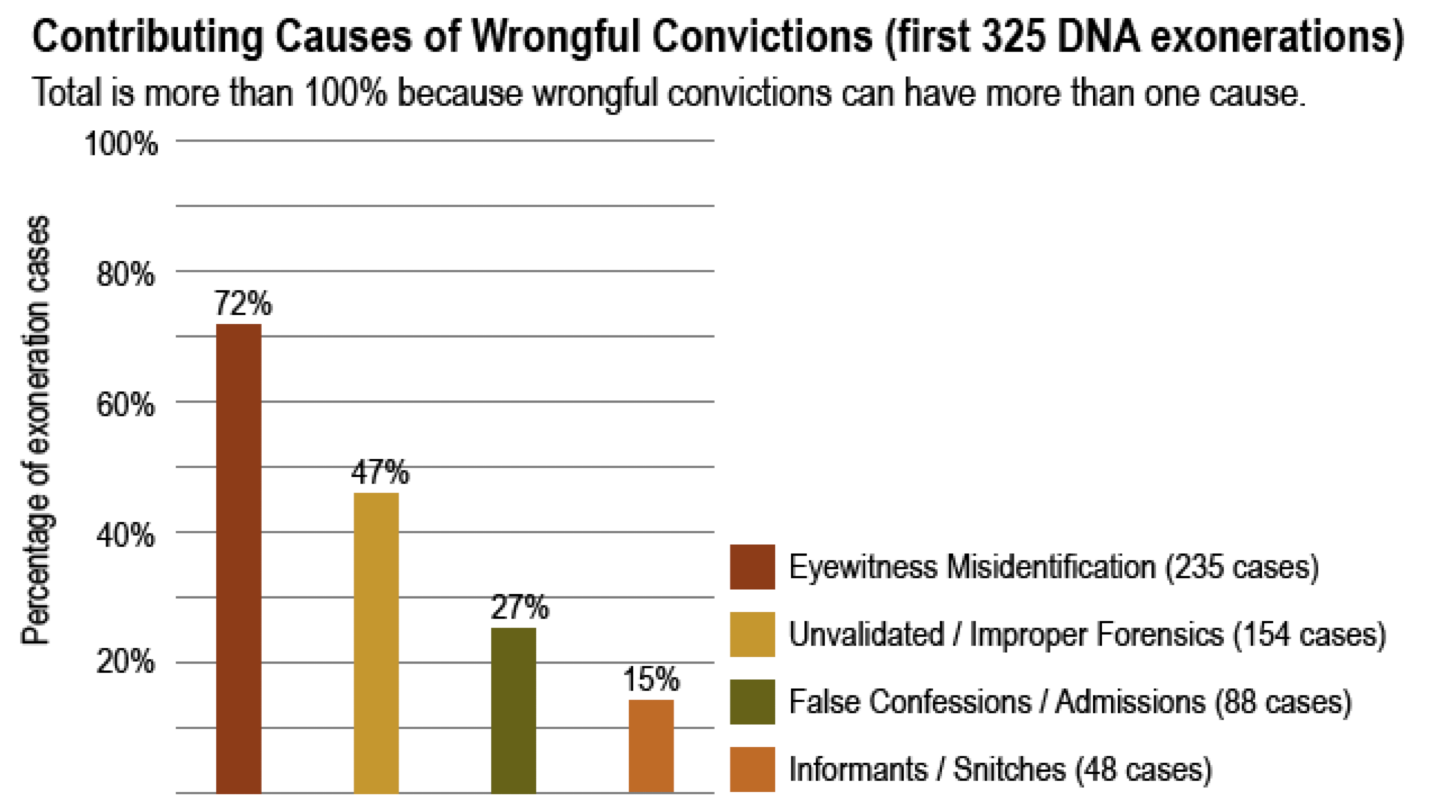
The consequences of contamination of memory of eyewitnesses have been tragic in the legal system by misidentifications of innocent suspects, or even reporting events that did not occur. Eyewitness misidentifications played a part in 70% of the 375 convictions that have been later exonerated based on DNA evidence since 1989. (Innocence Project).
Example :
1998: Miguel Solorio was a suspect of shooting. The police placed his photograph in a lineup, but on the first test, four witnesses rejected the lineup, providing reliable evidence of innocence.
2000 trial: Two of those same witnesses confidently identified him as the shooter, one with 100% certainty and the other with 75% certainty. Although there was no other evidence of guilt beyond the courtroom eyewitness identifications, Solorio was convicted and sentenced to life in prison without the possibility of parole. He was only 19 years old at the time of his arrest, and he spent, wrongfully, 25 years of his life behind bars.
2023: Exonerated due to understanding the importance of first-test uncontaminated memory.
Two other innocent prisoners who were exonerated a few months later were convicted for similar reasons.
Wrongful convictions harm innocent defendants and their families, victims of subsequent crimes committed by the true perpetrator and the public trust in the legal system.
Pathways to Reform: Strengthening Identification Procedures
A reform is needed for guidelines to be strictly used and respected during the initial identification process. Law enforcement must cover eyewitness factors and proper procedures for interviews and identifications through scientifically validated methods.
Education and training for (future) judges and attorneys: Include detailed courses on memory, eyewitness error in criminal law, criminal procedure and how to apply knowledge to cases.
Attorneys must have the opportunity to assess jurors’ attitudes and beliefs about eyewitness testimony.
Final Reflections on Eyewitness Reliability
Eyewitness memory, which takes an important place in trial, can easily be contaminated. Whether it’s during the encoding process, initial interview or at the trial, it’s almost impossible to have a perfect accuracy identification or testimony. A legal reform based on scientific-based evidence is needed, to the law enforcement to the courtroom people.
First and foremost, defendants are humans and a wrongful conviction can destroy lives - even resulting in the death penalty in some cases. Protecting the innocent requires acknowledging memory’s limits. Memory alone cannot be the foundation for guilt.
DOWNLOAD FACTSHEET AND POSTERS: https://drive.google.com/drive/folders/1Z_0CUuQte3wQzaeKUjBjTXZYRIvchujH?usp=share_link
To see more, follow me on other social media:
https://linktr.ee/themangionetrial
Bibliography:
An examination of the causes and solutions to eyewitness error (Wise et al.)
Can anxiety and race interact to influence face-recognition accuracy? A systematic literature review, (Tindall et al.)
Convicting with confidence? Why we should not over-rely on eyewitness confidence (Berkowitz et al.)
Eyewitness Confidence Malleability: Misinformation as Post-Identification Feedback, (Greenspan et al.)
Facial Comparison from CCTV footage: The competence and confidence of the jury (Walker and Tough)
Measuring lineup fairness from eyewitness identification data using a multinomial processing tree model, (Menne et al)
Rethinking the Reliability of Eyewitness Memory, (Wixted et al.)
The cognitive science of eyewitness memory (Mickes et al.)
The Dynamic and Fragile Nature of Eyewitness Memory Formation: Considering Stress and Attention (Wulff et al.)
 | A guest post by
|